
Read the Main Johnson County Property Tax Fields
The Johnson County record splits valuation from billing, and that split shapes how you read it. Beacon supplies the deeded owner, land and improvement values, deductions, and district data. The Treasurer sources provide the amount billed, the payment state, and delinquency clues.
| Field | What It Shows | Where |
|---|---|---|
| Land value | Assessed land component | Beacon / Assessor |
| Improvement value | Assessed buildings and improvements | Beacon / Assessor |
| Total assessed value | Value before applicable deductions | Assessor |
| Deductions | Approved reductions affecting taxable value | Auditor and Beacon |
| Tax bill and status | Amount due, paid or delinquent | Treasurer |
| Tax district | Applicable local units | County tax record |
Indiana assesses property at 100 percent of market value-in-use. That standard differs from a private appraisal and from the price a buyer might actually pay.
The Johnson County Tax List Searches Three Ways
The official tax-list portal from the Treasurer accepts three search routes: Property/Parcel Number, Name, and Property Address. The list runs 81,832 rows deep. Each page shows records 1-100, with Search, Clear, Next, and Back controls to move through the results.
| Field | Input tactic | Special caution |
|---|---|---|
| Property/Parcel Number | Use the county APN | Retain all segments |
| Name | Start with last name | Useful after split or combination |
| Property Address | Use fewer terms first | Too much text may narrow results |
The live page carries a "Not for Official Use" label. Treat it as a lookup index, and confirm the account with the Treasurer whenever accuracy matters.
Search and Pay Has Johnson County Account Filters
The separate Search and Pay portal filters by account number, owner name, owner mailing address, and property location. It adds Account Type, Include Inactive Accounts, Pay Status, and a required security check. Type an owner as last name first, followed by the first name or initial. For property location, enter the street number and name. Leave off street type and direction. Keep the dashes when you copy an account number from a statement.
Johnson County Statements and Installment Dates
The county mails statements each April, arriving by April 15. The general rule sets installments on May 10 and November 10, shifting to the next business day when a date falls on a weekend. For 2025, the posted due dates were May 12 and November 10. Never receiving a statement does not erase the tax duty. Because dates and penalties shift, check the current year's statement or the Treasurer page before paying. The Treasurer sits at 86 W Court St, Franklin, 317-346-4330, Monday through Friday, 8:00 a.m. to 4:30 p.m.
Follow a Johnson County Parcel From Value to Bill
Carry the same APN across both the assessment and tax views. A name or address can start the search, but the parcel number is the safer join.
- Find the parcel in Beacon and copy its APN and assessment year.
- Search the Treasurer list or Search and Pay account.
- Compare land, improvement, total value and applied deductions.
- Read the bill, payment status and any delinquency or sale notice.
- Assessed value
- The value placed on land and improvements for tax administration.
- Taxing district
- The group of local units and rates applying to the parcel.
- Deduction
- An approved reduction affecting taxable value.
- Tax lien
- A recorded or statutory claim tied to unpaid tax.
The 2026-2030 Johnson County Reassessment Cycle
Indiana's statewide cyclical reassessment starts July 1, 2026, for the 2026 Pay 2027 cycle. It touches roughly 25 percent of parcels each year across four years. Physical inspection covers improvements and property characteristics. Annual trending can shift values between those broad reviews too. Weigh each new figure against the correct prior assessment year. Property characteristics matter, and so do neighborhood or land-rate evidence. A value change does not always signal a sale.
Form 11 Starts the Johnson County Appeal Clock
The Notice of Assessment, Form 11, holds the value and appeal timing details you need. Form 130 is the taxpayer's notice that starts an Indiana appeal. The DLGF recommends objective evidence tied to the property and its assessment date. Check the official DLGF appeal source and Form 130 for current instructions.
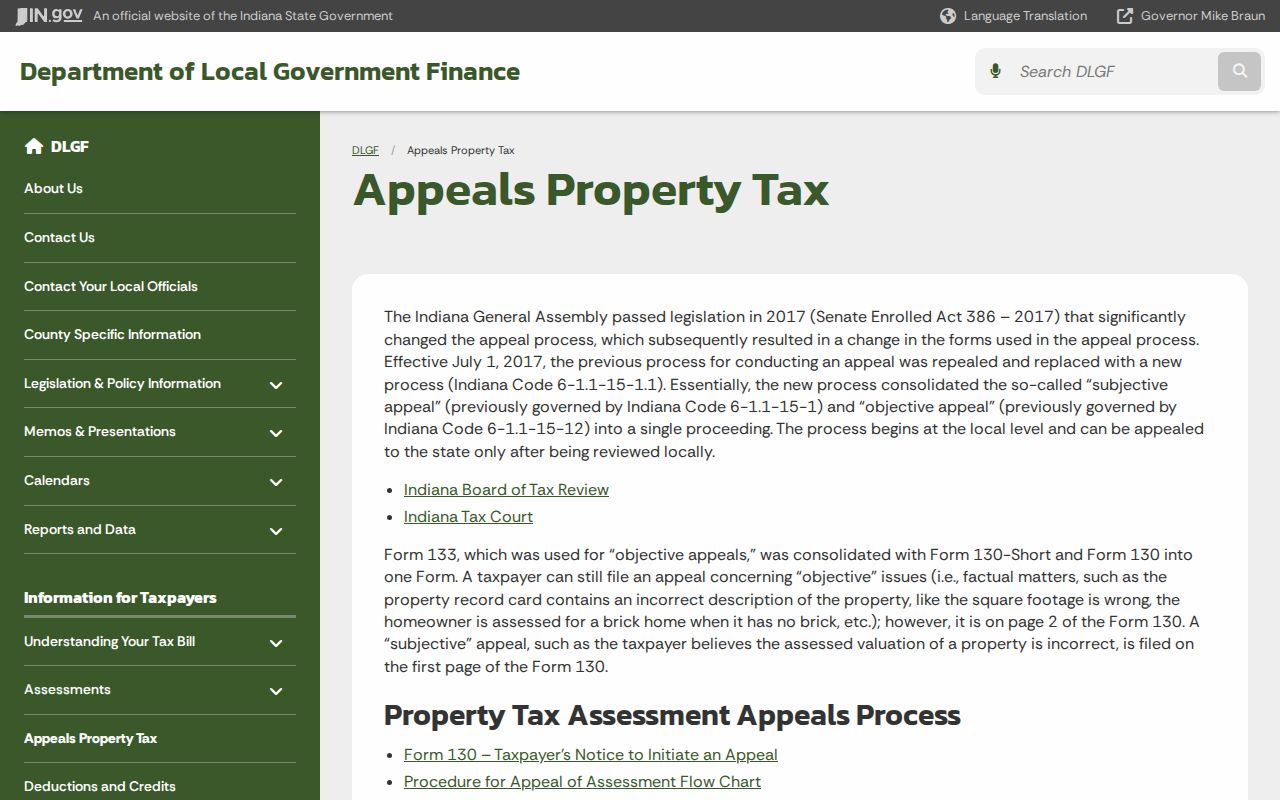
The state page maps out the appeal route. The parcel's Form 11 controls the facts and timing that govern the review.
Deductions and Mailing Changes Go Through the Auditor
Beacon displays deductions. The Auditor answers unresolved parcel and deduction questions at 317-346-4310 and jcauditor@co.johnson.in.us. Use the county service directory and current forms. Do not assume eligibility from a label on another parcel. A mailing address is not the situs address, and it proves nothing about ownership. Treat mailing changes, deed changes, and assessment corrections as separate office tasks.
Delinquency and Johnson County Tax-Sale Records
A delinquent balance can trigger statutory notice and tax-sale procedures. Check the Treasurer's current account and the sale material. Litigation shows up in the Clerk or court record. A single tax-list row does not prove a sale happened. It also does not prove that redemption has ended. Johnson County local court rules cover title-search material for tax-sale proceedings. Gather the deed chain, liens, taxes, and notices. Pull the sale result, redemption status, and eventual tax deed. Only then draw any ownership conclusion.
Johnson County Tax Districts Are Geographic Clues
A tax district can blend local units into one parcel. That mix may include a city, a township, a school corporation, a library, or another unit. One Greenwood sample carried Greenwood city, school, and library labels alongside Pleasant Township. That mixture is not an error. It simply reflects overlapping jurisdictions attached to the parcel. Mailing city, township, and incorporated boundary can seem to disagree. Use the district as a clue in that case. Confirm municipal status through JCMAPS or an annexation document, never the ZIP label alone. After an annexation, track any district change by its effective assessment and pay years.
Correct the Right Johnson County Tax Record
Route value and property-characteristic issues to the Assessor. Send deduction and parcel questions to the Auditor. Take bill or payment problems to the Treasurer. A Recorder deed correction is its own task. Handing one office another custodian's problem only delays the fix. Bring the APN, tax year, statement, and Form 11. Add supporting photos or sales evidence. Include any deed or plat that explains a split. Name the exact field you believe is wrong. When an online portal disagrees with an office record, request the current official entry and note the response date.
Tax Bills and Sale Prices Answer Different Questions
An assessed value keeps the tax system running. The tax bill then layers on deductions and rates. A deed record may show what a buyer actually paid. These figures answer different questions, and swapping one for another invites trouble.
Indiana ratio studies test assessments against qualifying market sales at the 100 percent assessment level. Even that statewide check cannot promise a property will sell for its assessed value. So treat the sale price as one fact. Keep the sale date, the assessment date, and the tax due date apart when comparing.
Contest a Johnson County Assessment With Evidence
Start with the Form 11. Compare the property's characteristics, land classification, and improvement data against market evidence for the valuation date. Then file Form 130 through the prescribed local route and keep proof of submission.
Remember, an appeal targets the assessment itself. The tax bill can shift for other reasons, since deductions and district rates play their part. Name the specific record you believe is wrong.
Appeal window. Use the deadline shown by the current Form 11 and DLGF instructions; the research does not support inserting one universal date for every notice.